Contents
How a research-led mid-funnel layer of CTV and streaming audio made Meta work harder for a coastal acreage lot release on Matagorda Bay.
How Do You Sell the Final Lots in a Nearly Sold-Out Community?
A coastal acreage lot community on Matagorda Bay, Texas, had one goal for late summer: fill an on-site sales event with qualified buyers from Houston and San Antonio. The remaining lots were the last of a nearly sold-out project, and the campaign had an 11-day window to deliver.
The community had relied on Meta for more than three years. It had reached the same audience so many times that the name itself had become background noise. The prior event ran on Meta alone, and cost per lead had been climbing all spring.
Spending more on Meta would only reach the same tuned-out audience more often.
Uniquely Digital started with research instead. A Uniquely ID’d analysis of real buyers showed this audience gives its attention to streaming TV first. So the team de-branded the offer, built a mid-funnel layer of CTV, streaming audio and Nextdoor around it, and kept Meta as the closer.
The campaign didn’t need a bigger Meta budget. It needed a warmer market for Meta to convert.
The Challenge: The audience had tuned out. Spending harder on Meta wasn’t going to fix it.
This was the third event campaign Uniquely Digital had run for the community that year. More than three years of reaching the same audience on Meta had left performance flat, and four problems were working against it at once:
- Ad fatigue. Anyone who had seen the ads already knew the name, and they weren’t responding again.
- A single-channel ceiling. The prior event ran entirely on Meta. With no upper or mid-funnel support, every lead depended on Meta finding cold, fatigued prospects and converting them in one step.
- Sellout mode. The last lots of a nearly sold-out community are a harder story to make feel new.
- Rising cost to acquire. Cost per Meta lead had been climbing through the spring.
The question wasn’t how to get more out of Meta. It was what this buyer would pay attention to that they hadn’t already seen.
This buyer was watching, not scrolling.
Before building the plan, Uniquely Digital ran a Uniquely ID’d buyer analysis on more than 300 prior tour and purchase records, matching and profiling about 65% of them. The read was clear: this is a streaming video and TV audience first. Social reach was meaningful but lighter, and every print channel tested came back statistically insignificant.
This buyer watches first and scrolls second
Uniquely ID’d analysis of prior tour and purchase records, ranked by attention
- 01 Streaming TV 38% medium and 21% heavy usage Deepest media habit, never bought for this community Mid-funnel reach
- 02 Facebook 75% membership The backbone, but fatigued after 3+ years Lower-funnel capture
- 03 Nextdoor Indexed 139 vs. the buyer profile Local, low-competition reach in both markets Local reach
- 04 Print Statistically insignificant Every print channel tested Left out of the plan
Figure 1 · Where this buyer’s attention sits · source: Uniquely ID’d buyer analysis
Who the buyer is: ages 35 to 64, $75K+ household income, married with children, homeowners. Affluent, family-centered suburban households clustered in places like Katy, Sugar Land, The Woodlands and New Braunfels.
Our Solution: Change what they see and where they see it.
This was not “we added channels.” Uniquely Digital rebuilt the plan around where this buyer actually spends attention, then let Meta do what it does best.
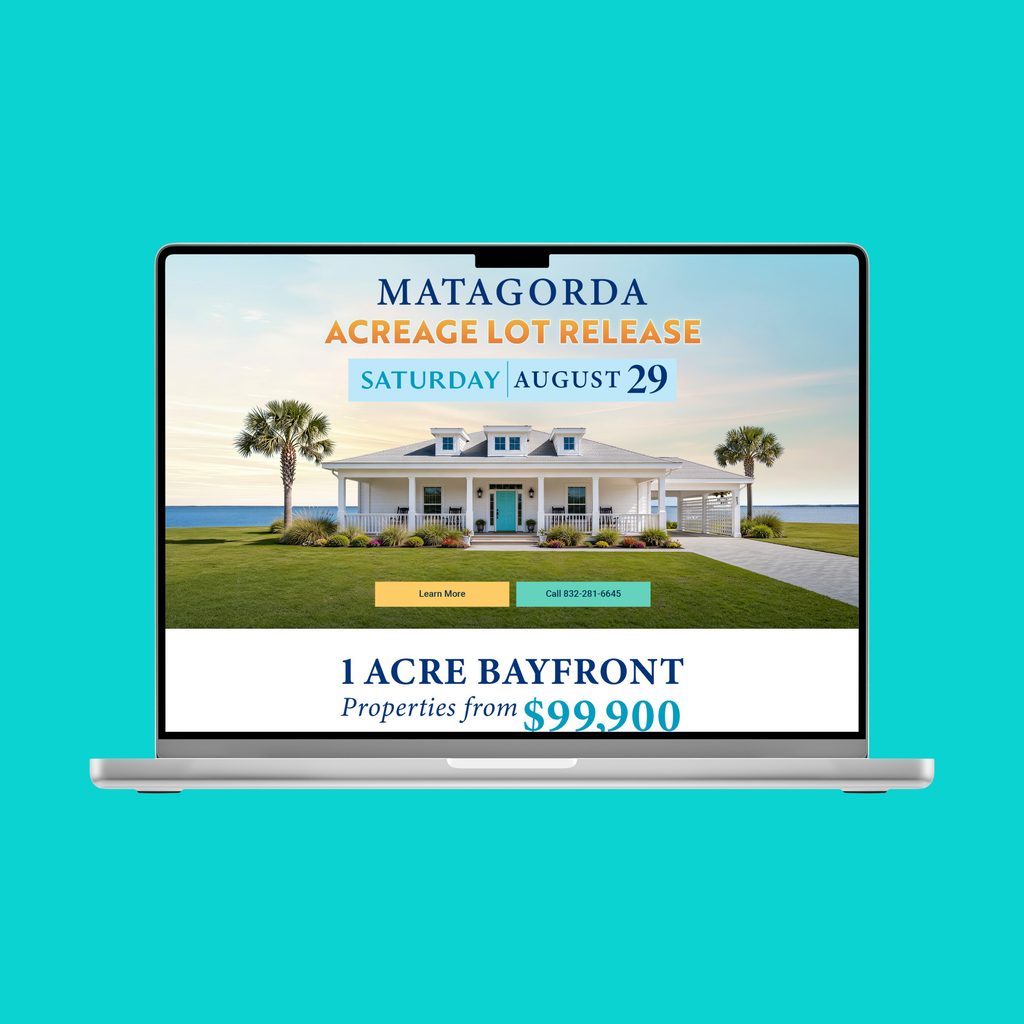
- De-branded the offer. The campaign relaunched as the “Matagorda Bay Acreage Lot Release,” with no community name in any ad or on a new landing page. Fatigued viewers saw it as something new.
- Added a mid-funnel layer. CTV and streaming audio introduced the offer to new buyers in their highest-attention media. Nextdoor added local reach.
- Kept Meta as the closer. Unbranded Meta prospecting and retargeting converted the warmer market that the mid-funnel layer built.
CTV and audio warm the market, Meta closes it
- CTV
- Streaming audio
- Nextdoor
Figure 2 · How the plan fit together
| Channel | Funnel role | Why it was in the plan |
|---|---|---|
| Meta Unbranded | Lower funnel Lead capture | Proven lead driver for land. Prospecting on a Uniquely ID’d buyer audience, plus retargeting. |
| CTV | Mid funnel Reach and consideration | The buyer’s number one media behavior, never bought for this community. |
| Streaming audio | Mid funnel Reach and frequency | Extended the CTV story into listening time with the repurposed CTV voiceover. |
| Nextdoor | Mid to lower funnel Local reach and leads | Indexed 139 against the buyer profile. Geo-relevant, low-competition reach. |
The Four-Pillar Strategy
Intro: Every Uniquely Digital campaign runs on four pillars. Here is how each one was applied to this lot release.
Four pillars, applied to one lot release
- 01 Audience Research Uniquely ID’d analysis of real buyers showed where attention goes
- 02 Media Strategy CTV, audio and Nextdoor warm the market. Meta closes.
- 03 Digital-First Design Unbranded offer and a new landing page made it feel new
- 04 ROI and Attribution One landing page as the conversion point for every channel
1. Audience Research
More than three years of Meta history pointed to diversifying the plan, not spending harder.
- A saturated audience and a performance plateau told the team that more Meta frequency would not move the number.
- The Uniquely ID’d buyer analysis profiled real tour and purchase records to find who buys coastal acreage and what media they consume.
- Meta prospecting ran on a Uniquely ID’d audience modeled on real buyers by age and household income, across the Houston and San Antonio markets.
2. Media Strategy
Each channel had one job in the customer journey.
- CTV reached 318K+ households, with 98% of ads watched to completion.
- Streaming audio reached 155K+ unique listeners, with 95% heard to completion.
- Nextdoor added neighborhood-level reach across both markets, with 74% of delivery in the highest owner-occupied areas.
- Meta prospecting and retargeting turned that interest into leads.
Timing: the flight launched 11 days before the on-site sales event, because spend closer to the event drives a higher show rate.
Real-time optimization: daily cross-platform and geo monitoring drove two key calls.
- Day 4: hold the plan. Meta was converting well below the prior two months’ cost, and landing page conversion was running about 2x historical. The team held budget steady through the weekend instead of reacting to early lead counts.
- Three days out: harvest the demand. CTV and streaming audio were driving traffic more than direct leads, so 25% of their remaining budget moved to Meta for the final three days to convert the demand they had built.
Eleven days of media, timed to the sales event
Flight dates by channel and the two in-flight optimization calls, August 2026
-
Meta
Aug 18 to 28
-
Nextdoor
Aug 18 to 28
-
Streaming audio
Aug 19 to 28
-
CTV
Aug 20 to 28
-
Day 4: hold budget
Aug 22
-
Shift 25% to Meta
Aug 25
-
On-site sales event
Aug 29
Figure 3 · Flight timeline and optimization calls · source: brief, Aug 2026 flight
3. Digital-First Design
A new name and a new look made a familiar offer feel new.
- Every ad and a new unbranded landing page carried the “Matagorda Bay Acreage Lot Release” positioning.
- Creative was built to travel: the CTV voiceover was repurposed for streaming audio, and Meta creative was adapted for Nextdoor.
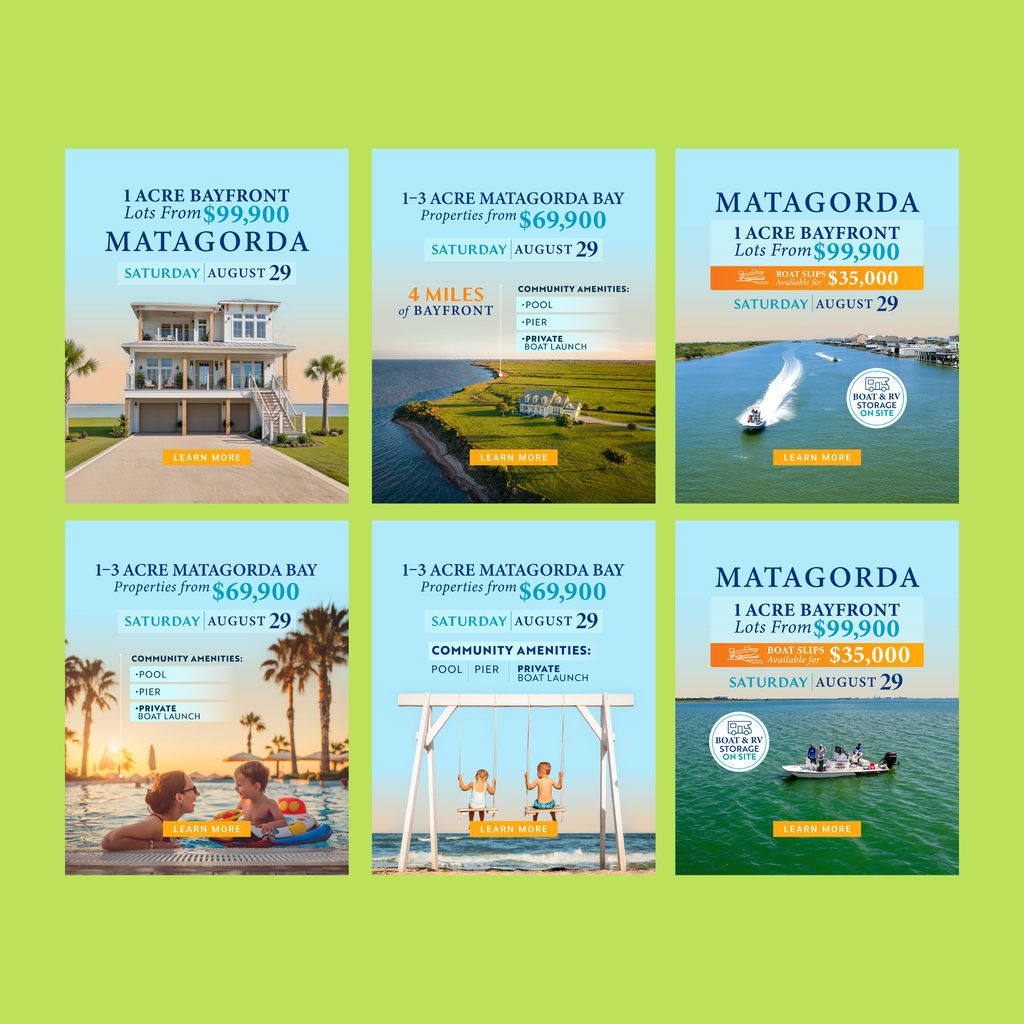
- Lifestyle creative beat property-only creative, so more lifestyle concepts were built mid-flight to keep momentum.
Figure 4 · Top Meta creatives by share of Meta leads (instant form plus landing page)
The top five concepts drove 78% of Meta leads, and the two family lifestyle concepts alone drove a third.
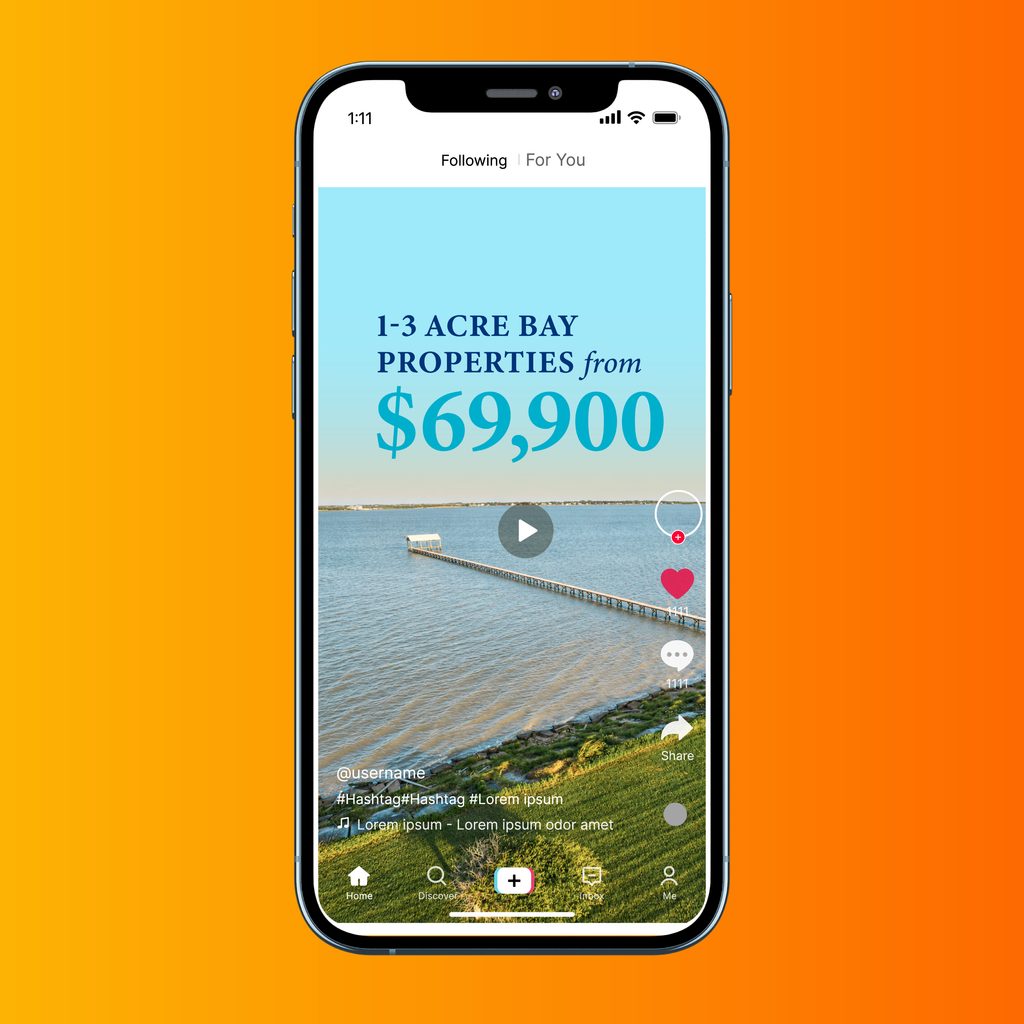
Highlights of the Land Campaign Creative
4. ROI and Attribution
One conversion point made the whole plan measurable.
- The unbranded landing page was the single conversion point across every channel, so mid-funnel traffic and landing page conversion could be read in one place.
- The prior Meta-only flight and this one were compared like for like: same 11-day length, same prospecting plus retargeting structure, same lead definition, and total investment measured the same way in both.
What Changed and Why: Same Meta reach. A much warmer market.
Before: every lead depended on one channel. Meta had to find a cold, fatigued prospect who already knew the name and convert them in a single step.
After: CTV and streaming audio reached new buyers where they were already watching and listening. Those buyers visited the site, the retargeting pool filled with warmer prospects, and Meta converted them.
Same Meta ad, a much warmer buyer
Meta only, to a cold and fatigued audience
- Meta ad
- Name seen before
- Ad tuned out
- One-step lead
CTV, streaming audio and Nextdoor warm the market first
- Mid-funnel ad
- Site visit
- Retargeting pool
- Meta lead
Figure 5 · Two customer journeys
Meta reach held nearly flat (+2.7%). Everything downstream of it moved: link click-through rose 35%, landing page traffic rose 158% and landing page conversion rose 79%. The lift showed up exactly where warmer traffic should show up.
Leads and traffic grew faster than investment
Lot release vs. the prior Meta-only flight, as a multiple (prior flight = 1x)
- Total investment 1.6x
- Meta leads 2.1x
- Landing page traffic 2.6x
- Total impressions 2.8x
- Retargeting leads 4.6x
Figure 6 · Growth vs. investment · source: brief, June vs. August flights
Every downstream rate rose on nearly flat Meta reach
Prior Meta-only flight vs. lot release, percent
- Prior flight
- Lot release
-
Meta link click-through rate
Prior flight 1.02%Lot release 1.37%
-
Landing page conversion rate
Prior flight 1.52%Lot release 2.72%
-
Retargeting conversion rate
Prior flight 1.39%Lot release 3.56%
Figure 7 · Rate lift · source: brief, June vs. August flights
Retargeting proof point (callout): With CTV and streaming audio warming the market, retargeting delivered 4.6x the leads of the prior Meta-only flight. The retargeting audience grew 25%, and its conversion rate rose 157%, from 1.39% to 3.56%.
| Metric | Prior flightMeta only | Lot releaseFull plan | Change |
|---|---|---|---|
| Total campaign investment | Base | 1.6x | +60% |
| Total campaign impressions | 641K | 1.82M | 2.8x |
| Meta reach | 282K | 290K | +2.7% |
| Meta link click-through rate | 1.02% | 1.37% | +35% |
| Landing page traffic | Base | 2.6x | +158% |
| Landing page conversion rate | 1.52% | 2.72% | +79% |
| Retargeting audience reach | Base | 1.25x | +25% |
| Retargeting conversion rate | 1.39% | 3.56% | +157% |
| Retargeting leads | Base | 4.6x | +357% |
| Total Meta leads | Base | 2.1x | +111% |
Results: Leads grew nearly twice as fast as investment.
- 2.8x the media footprint on 60% more investment. Total impressions nearly tripled as the plan grew from Meta alone to Meta, CTV, streaming audio and Nextdoor.
- 2.1x the Meta leads. Leads rose 111% against a 60% increase in total investment.
- Same Meta reach, far more action. Click-through up 35%, landing page traffic up 158%, landing page conversion up 79%.
- 4.6x the retargeting leads on a retargeting audience 25% larger, the clearest sign of mid-funnel lift.
- New reach where the buyer spends attention. 318K+ CTV households at 98% completion and 155K+ streaming audio listeners at 95% completion. 63% of all impressions ran outside Meta.
The playbook (3 steps):
- Research where the buyer’s attention actually goes before adding spend.
- Build a mid-funnel layer in those channels to warm the market.
- Let Meta close, and protect the plan with daily cross-platform monitoring.
“We kept the Meta investment flat and built a mid-funnel layer around it. CTV and streaming audio reached new buyers where they were already watching and listening, and Meta converted that interest at twice the volume. The lift didn’t come from one channel outperforming. It came from a plan built on research into who buys coastal acreage and where they spend their attention.”– Brandon Buras, Chief Innovation & Strategy Officer
Is your audience tuning you out?
Uniquely Digital finds where your buyers actually spend their attention, then builds the plan around it. Let’s look at what your next campaign could do.