



How Residential Land Developers Can Connect Sales Event Attendance Back to Digital Ads
What We’ll Cover
- Why land sales attribution is uniquely broken in 2026, and why “lead volume” is lying to you
- The January 2026 Meta attribution-window change that quietly cratered your reported ROAS
- The DDA threshold trap inside GA4: why you’re probably running on last-click and don’t know it
- The three layers of measurement (and why your CRM is the only one that pays bills)
- The hybrid fix: server-side tracking plus a 5-stage qualified-lead ladder fed back from your CRM
- How to actually triangulate Meta vs. GA4 vs. CRM during your next weekend sales event
Land Sales Marketing in 2026: The Old Playbook Is Costing You Sales
If you develop and sell residential land, that’s anything including acreage communities, master-planned developments, waterfront lots, build-on-your-own-timeline communities, then you’ve felt the shift over the last 24 months.
Direct mail costs are climbing while response rates fall. Meta lead volume that used to flow on autopilot has dropped, and the leads that do come in often can’t qualify for financing or never pick up the phone. Your sales team spends Saturdays at the model home, but you can’t tell which marketing channel actually drove the people who showed up, let alone the ones who signed.
This isn’t only a creative problem. It’s a measurement and attribution problem. And it’s hitting land developers harder than almost any other category in 2026.
A reality check from the field: “One of the biggest mistakes I see land developers make is optimizing for whoever raises their hand first instead of who can actually buy. When you customize your audience around qualifiers like lifestyle and true purchase intent, everything changes. Your tours improve, your conversion rates increase, and your marketing starts driving real land sales.” — Brandon Buras, Chief Innovation & Strategy Officer, Uniquely Digital
The Five Shifts That Broke Land Sales Measurement
Five discrete events between 2021 and 2026 invalidated how land developers used to measure ad performance and the most damaging one happened just months ago.
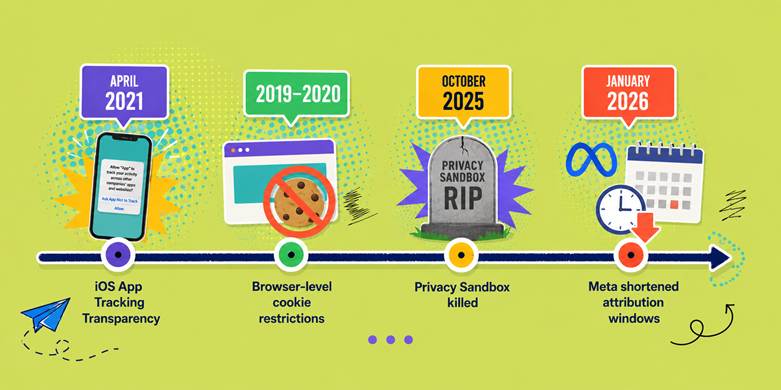
| When | What Changed | Why It Hurts Land Developers Specifically |
| April 2021 | iOS App Tracking Transparency | ~75% of iOS users opt out of tracking. The high-net-worth buyers who skew Apple are the least visible to Meta deterministically. |
| 2019–2020 | Browser-level cookie restrictions | 30%+ of browsers were already cookieless before Chrome’s saga. Your retargeting pool is smaller than your dashboard implies. |
| October 2025 | Privacy Sandbox killed | Google scrapped its 5-year cookie replacement after 85% attribution inaccuracy in CMA testing. No cavalry coming. |
| January 2026 | Platforms shortened attribution windows | Meta removed 7-day view entirely. Default is now 7-day click, 1-day view, punishing view-through awareness. |
| March 2026 | Meta Update | Click-through redefined to link-clicks only plus the new engage-through bucket separately measures conversions influenced by actions |
That last one on March 2026, is the punch most land developers haven’t fully absorbed yet.
Why the New Meta Window Quietly Cratered Your Reported ROAS
Land sales operate on multi-week, often multi-month decision cycles. A buyer sees a Meta ad in early March, attends an event in late March, gets qualified in April, signs in May. Historically, attribution windows gave marketers more visibility into that journey. But the 2026 Meta updates introduced major changes that made long-cycle measurement significantly harder. The result; fewer conversions remain attached to campaigns inside standard reporting, even when marketing performance has not changed.
- High-consideration verticals (real estate, B2B, land): Reported performance will look 15–25% worse than reality on accounts with 14–30 day decision cycles.
- View-through dependent campaigns (CTV, awareness): With only 1 day of view credit and engage-through reporting split out separately, upper-funnel channels like CTV and awareness Meta campaigns may appear to drive few or no conversions when reading platform data alone.
- Lead generation campaigns: If your CRM shows leads coming in 8+ days after the original click, they’re now uncounted by Meta. The current default is 7-day click, 1-day engage-through, 1-day view, and as of March 2026 only link clicks count as click-through.
For land sales events and the complete buyer journey multi-week cycles and view-through measurement are critical to understanding and optimizing campaign performance.
Server-side tracking with offline event uploads is no longer optional, it’s mandatory.
If your Meta numbers have looked off since Q1, this is most likely why.
Why Land Sales Attribution Is Uniquely Broken
Beyond the platform changes, three structural forces stack up to make attribution especially hard for land developers:
1. The Special Ad Category Trap
Real estate and land ads sit inside Meta’s Special Ad Category, which strips away age, ZIP-code, and many of the demographic filters other industries take for granted. Campaigns are forced to run broadly and hand more control to the algorithm. The algorithm then finds the cheapest people who’ll engage with your ad. With property creative, that means aspirational browsers, “someday” dreamers, and people who love the idea of land ownership but can’t write the check.
2. The Aspirational Audience Problem
Land creative is naturally magnetic. A drone shot of a lakefront lot at sunset is going to attract clicks from people who could never qualify for financing. Without targeting guardrails or downstream filtering, you’re paying to attract beautiful, low-intent traffic, and your closers are spending Saturdays running interference on tire-kickers instead of selling lots.
3. The Online-to-Offline Black Hole
This one is the kicker. Land sales close in physical, in-person moments: a model home walkthrough, a property tour, a weekend sales event, a financing conversation, a contract signing. None of those events fire a pixel. Unless you’re explicitly piping that data back to your ad platform, Meta and Google have no idea which leads ever became real buyers, so they keep training on what they can see, which is form fills.
Did you know? Meta’s pixel-only tracking is now hitting roughly 40% accuracy without server-side support. Server-side tracking via the Conversions API typically recovers attribution accuracy to 60–75%, about 30 points back per account.
The DDA Trap Hiding in Your GA4 Dashboard
There’s another quiet attribution failure most land developers don’t know they have: their GA4 isn’t actually doing what they think it is.
GA4’s data-driven attribution model needs 400+ conversions per key event AND 20,000 total in the lookback window to actually run. For most land developer accounts, where a “conversion” might be a lead form, a tour booking, or a financing app, those volumes simply don’t exist month to month.
When a property is below threshold, GA4 silently reverts to last-click without warning. The dashboard still looks like DDA. It isn’t. You can audit it under Admin → Property → Attribution Settings.
The bigger picture: as of November 2023, GA4 deprecated first-click, linear, time-decay, and position-based models entirely. Inside GA4, only DDA and last-click are still selectable. For long-cycle, high-consideration purchases like land, that’s a particularly cruel trade-off, the channels doing the awareness work (CTV, programmatic, top-funnel Meta) get punished the most.
The Three Layers of Land Sales Event Ad Campaign Measurement, Ranked by Trust
The most important reframing for any land developer in 2026: stop trying to make Meta and GA4 agree, and start ranking your data sources by trust.
| Layer | Source | Best for | Watch out for |
| 01 — Platform Data (lowest trust) | Meta Ads Manager & Google Ads | In-platform optimization, learning phase decisions, creative testing | Each platform claims credit it didn’t earn. Never use as the source of truth for budget decisions. |
| 02 — Analytics (medium trust) | GA4, third-party attribution tools | Channel mix, journey analysis, paid vs. organic | Lossy from cookie restrictions. DDA threshold issues. Modeled conversions everywhere. |
| 03 — Source of Truth (highest trust) | Your CRM, signed lots, qualified buyer data | Budget decisions, channel kill/scale calls, ROAS reporting | Lacks attribution context — your CRM doesn’t know which channel drove the buyer unless you feed it back. |
Platform data is for optimization. CRM is for decisions.
A Triangulation Example for Land
Here’s what this looks like for a real weekend sales event:
| Source | What It Shows and Why |
| Meta dashboard: 80 leads | 7-day click window credits leads even when the user returns later via direct/organic. Plus form spam, modeled iOS conversions, duplicate registrations. Most inflated. |
| GA4: 52 conversions from Meta | Last-click within session. A user who clicked Meta on Tuesday and came back direct on Friday gets tagged as direct, not Meta. Closer to reality but undercounts Meta’s true influence. |
| CRM: 31 qualified attendees, 6 signed lots | Real humans the sales team talked to. Real contracts. Blind to the journey, but the only number anchored to revenue. The number you make budget decisions on. |
If a developer looked at the 80 vs. 52 vs. 31 split and said “cut Meta,” they’d be wrong. The CRM number says the campaign is performing, it’s just measuring different things at different points in the funnel. The fix is to feed the CRM data back to Meta so the algorithm starts learning what real buyers look like.
The Hybrid Fix: Server-Side Tracking + the 5-Stage Qualified Lead Ladder
Land developers need the same hybrid measurement model every modern advertiser needs, but applied to a buying journey that lives mostly offline. Here’s what that looks like in practice.
Step 1: Plug the Pixel Leaks with Server-Side Tracking
Server-side tracking moves your conversion events out of the browser and routes them through a server you control before they’re sent to Meta and Google. You’ll capture more events, pass higher-quality identifiers (hashed email, hashed phone, the all-important fbclid Facebook Click Identifier), and use event IDs to deduplicate so reporting stays clean.
Our standard infrastructure for this is service-side tracking container, server-side Google Tag Manager hosting that runs on a custom subdomain, looks like first-party traffic to ad blockers, and ships native integrations with Meta CAPI and Google Enhanced Conversions. The flow:
- Website event fires: a tour RSVP, a financing application, a downloadable request.
- Sent to a server-side sGTM container on a custom subdomain (no ad blocker triggers).
- Server-side tracking forwards to platforms: Meta CAPI and Google Enhanced Conversions.
- CRM enrichment: qualified leads, tour completions, and signed lots pushed back as offline events.
Number 4 is where most agencies stop and where the actual ROI of the system lives.
Step 2: Stop Optimizing for “Lead.” Start Optimizing for Qualified Lead.
This is the single biggest unlock for land developers and the one almost nobody is doing right.
When you optimize a Meta or Google campaign on the “lead” event, the algorithm builds a profile of “people who fill out forms.” That’s not the audience you want. You want the audience that shows up, qualifies, tours, and buys.
The hybrid approach lets you redefine what counts as a conversion by feeding deeper milestones from your CRM and sales process directly back to the ad platforms. We call it the Qualified Lead Ladder, and for land it looks like this:
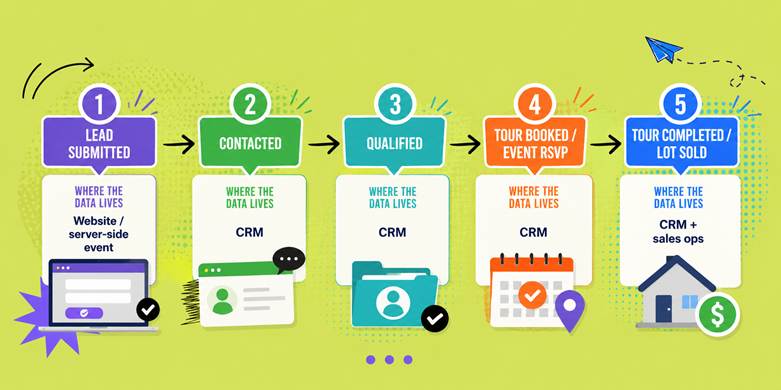
| Stage | What triggers it | Where the data lives |
| 1. Lead Submitted | Form fill on landing page | Website / server-side event |
| 2. Contacted | First sales touch logged | CRM |
| 3. Qualified | Budget + timeline + financing fit confirmed | CRM |
| 4. Tour Booked / Event RSVP | Appointment scheduled | CRM |
| 5. Tour Completed / Lot Sold | On-site visit confirmed; contract signed | CRM + sales ops |
Every one of those stages can be passed back to Meta (Conversions API) and Google (Offline Conversion Imports) on a regular cadence using the same hashed first-party identifiers your CRM already stores. Once that loop is in place, you can tell the algorithm: *”Don’t show this ad to people who’ll fill out a form. Show it to people who’ll get qualified and book a tour.”*
Step 3: Send the In-Person Sales Event Back to the Algorithm
For weekend sales events, you have a uniquely measurable in-person moment. When attendees check in at the table, you have a name and a phone number. When a lot goes under contract Saturday afternoon, you have a buyer.
Hash that data. Push it back. Tag it to the campaigns that drove RSVPs. Suddenly your “lifestyle vision” CTV ad doesn’t just look like an awareness play, it looks like the channel that filled the room.
FYI: We typically build a weekly or post-event match-back cadence into every land sales engagement. CRM data flows back to Meta, Google, and the programmatic stack within 72 hours of the event closing, so the algorithm starts learning from real revenue while creative is still in market.
Match the Attribution Model to the Channel’s Job
The other major shift land developers need to make is moving away from “one model for all reporting.” Different channels do different jobs in the funnel, and applying the wrong attribution lens punishes the channel that did the work.
| Funnel Position | Best Attribution Lens | Examples for Land Developers |
| Top: awareness, demand creation | First-click thinking | CTV (Hulu, YouTube TV, Roku, Amazon Prime), programmatic display, top-funnel Meta video |
| Middle: consideration, nurture | Linear / time-decay / position-based | Mid-funnel Meta carousels, retargeting, email nurture |
| Bottom: conversion, capture | Last-click | Branded search, direct retargeting at financially qualified audiences |
| Full funnel | Data-driven (only when volume allows) | Multi-channel programs with sustained 400+ monthly conversions |
If you’re applying last-click to your CTV campaign, you’re going to conclude CTV doesn’t work, even when it’s filling your sales event. If you’re applying first-click to branded search, you’re going to drastically over-credit it. The model has to match the job.
Pro tip: When platform attribution falls short, especially for awareness and CTV, use incrementality testing instead. A 30-day holdout test (pause the channel, watch what happens to total tour bookings, then make the call) is the only honest way to answer “is this channel worth it?”
The Land Developer’s 2026 Measurement Stack at a Glance
| Layer | Purpose | What It Catches |
| Server-side tracking + CAPI | Captures website events bypassing browser blocks | Form fills, downloads, RSVPs, page conversions |
| First-party identifier passing | Improves match quality at the platform | fbclid, hashed email, hashed phone |
| CRM milestone events | Feeds qualified lead progression back to ad platforms | Contacted, Qualified, Appointment |
| Offline event match-back | Connects in-person tours, events, contracts | Event check-ins, tour visits, signed lots |
| Holdout / incrementality tests | Answers “would we have closed anyway?” | True channel ROI for CTV, awareness, branded |
Each layer is meaningful on its own. Stacked together, they recover the visibility Meta’s privacy and Special Ad Category restrictions took away, and give your campaigns a buyer-quality signal the algorithm can actually optimize against.
What Real Results Look Like
When the hybrid model is in play, land campaigns don’t just look better in dashboards, they sell more lots. A few outcomes from our recent land development work:
- Premium Waterfront Community, North Carolina: Built precise targeting on lifestyle qualification signals, layered Meta + Google Search + CTV with conversion-driven creative. Result: 50% of premium lots sold in one weekend for a brand-new market entry with no historical data.
- Residential Acreage Community, North Texas: Restructured campaign strategy with qualified audience segments, expanded beyond Meta to OTT/CTV and SEM, launched a conversion-optimized landing page. Result: CPL dropped 69% and lead volume grew 221% on the same budget, while uncovering which audience segments delivered the strongest tour and purchase rates.
- Solutions for Declining Lead Gen: You can see the full case study on our marketing strategy for selling land.
Build a Sales-Event Engine, Not a Lead Bucket, with Uniquely Digital
Land developers don’t need more leads. You need the right leads, the ones who can show up, qualify, and sign. That requires marketing infrastructure built specifically for the way land actually sells: high-consideration, high-touch, and mostly offline.
At Uniquely Digital, our four-pillar approach is built around this exact problem:
- Razor-sharp audience targeting with high-intent and lifestyle overlays your in-house team can’t access alone.
- Tailored media planning across Meta, Google, CTV, and SEM – calibrated to each community’s buyer profile.
- Digital-first creative that sells the future, not just the lot.
- Hybrid measurement and attribution – server-side tracking, CRM match-back, and incrementality testing, that closes the loop from ad impression to signed contract.
Measurement isn’t math. It’s judgment. The numbers on Meta, GA4, and your CRM are never going to perfectly agree. The goal is to know why they disagree, which one to trust for which decision, and how to translate that clarity into more sold lots.
Are you ready to drive genuine growth from your land sales strategy? Let’s talk.